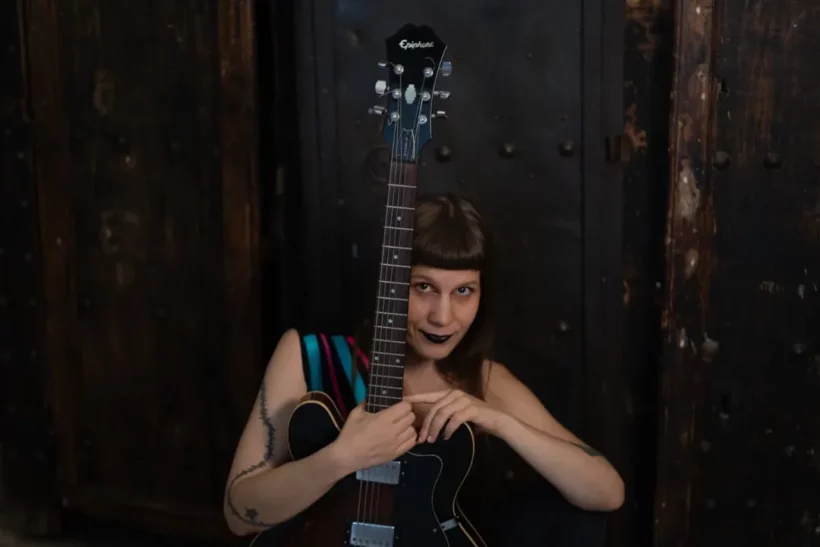
On Femme Metal Webzine, we welcome Italy’s dreamgaze Julinko back into the orbit of Naebula, her swirling, still‑half‑hidden wave of sound and feeling. Two singles, Cloudachine and SKIN DRESS, have already landed with striking mini‑films, while the full album was released at the end of January. Naebula is more than a record: it’s the outcome of years of live experimentation, of standing alone on stage and letting loops, mistakes, and moods slowly crystallize into the most authentic album she’s ever made—a “screenshot” of fluid emotions and a sound defiantly her own.
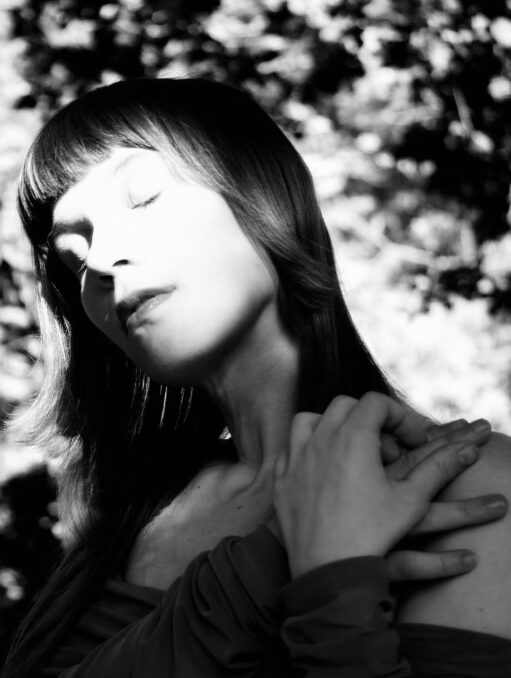
Welcome to Julinko
So, first of all I want to welcome you to Femme Metal Webzine, Julinko. And I wanted to ask you how you are, how Naebura‘s promotion is going.
Thank you. I’m fine, I’m very… I feel quite excited. I have to say, I feel like there’s a wave that’s taking shape, a wave that started a while ago. It is a lively period, even if still a little behind the scenes, a little hidden.
The promotion went well, for now two singles have been released accompanied by two video clips. But some articles have come out, among other things a first review has come out that has not yet been published… let’s say disclosed, but an excellent review came out on The Wire coupled with the album by Hilary Woods, who is one of the artists that I really liked so much in recent years.
Julinko working with a new label
So I’m very happy, I’m working with a new base label Maple Death Records and Avantgarde Music, which I had already worked with because I released Sacred Wood with them. It’s a good collaboration and so I’m confident, I’m happy and let’s see. Let’s see how it goes. Yes, we can only talk about the present, let’s say.
About the production of Naebula
So, I wanted to ask you how you started building the production of Naebula. Because today I had time to listen to the album, first of all I congratulate you and then thank you, and then the second moment I wanted to ask you when did you start to have the first ideas for this album, because it’s nice massive, it’s fantastic, I like it a lot, I’m honest, but I also understand that it must have been a very long process.
Yes, indeed it is; Now that you ask me this question I also make things, in the sense that the production itself, I went to the studio to record it in May 2024, so I’ve been recording it for a while now. But before recording it, of course, I prepared myself to go to the studio, and let’s say that these compositions are the result of different moments and different areas of my career as Julinka.
About the production of Naebula [cont]
Let’s say that most of the songs were born during and entered their essence a bit live. In the sense that initially with Julinko I performed in a duo, then in a trio. At a certain point I decided that I wanted to face it alone, because I wanted to understand if I could hold the live on my own, with my own means, let’s say. I wanted to make everything very simple and fluid and I wanted to deal with the fear of making mistakes a bit.
About the production of Naebula [cont]
Let’s say that I said to myself: if I’m on stage alone and I’m wrong, I can turn that mistake into anything. So let’s say that some songs, that is, most of the songs, were born from very simple chorus, in fact from loops with repeating turns and so on. And then they were developed a lot live, also because in the live shows I did, in particular I had an experience with Imes, I did a tour in support of Imes in 2023, in which I knew during the performance where, on which junctions to pass, but I didn’t really have the structure of the songs and so on. So it’s a lot, it’s very fluid from a certain point of view.
Julinko: “It is also a process of acceptance”
Yes, it’s interesting because, quoting what you have just said: “yes, I decided to make a mistake on my own, if I make a mistake it’s to face everything alone”. At some point you decided not to compromise on yourself anymore, to admit it even so in the end.
Yes, oh well, I find it hard to see it that way, but because it is also a process of acceptance, let’s say, it is not easy sometimes to accept one’s vocation entirely. Understandable. So sometimes you put limits or appreciation towards what you can do, which obviously come to you from legacies, traumas, previous lives, put what you want in it. But yes, let’s say that I had this curiosity to explore an entire sound space with my own means.
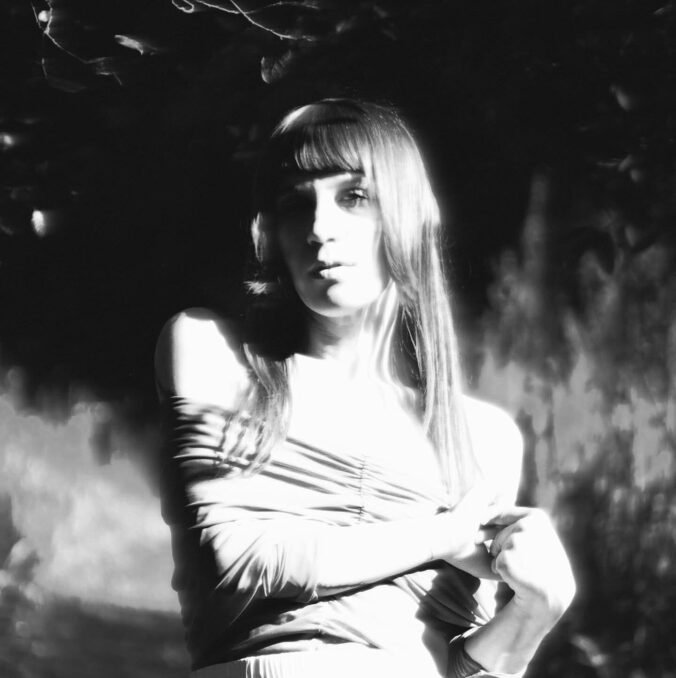
Julinko: “It is also a process of acceptance” [cont]
Since I started composing… not knowing how to play, that is, I am self-taught from the point of view of instruments, and immediately I started playing with people who instead had a lot of experience and I am very grateful for this. But in certain moments of my path I had a bit of this prehension of, you know, like making a mistake and then ruining the lives of others from a certain point of view. And on the other hand, however, I was not at the level of improvisation, at a technical level, to say “if I make a mistake I understand myself immediately with the others”.
And so Naebula was born…
So, on the one hand, follow your own inspiration without having external limits. You go on stage, you have instruments and from there they give you a space. You have tools and there is you, do what you want. I liked to explore this stuff here, a lot. And so Naebula was born from this thing here.
Julinko: “I realized that it was worth doing”
Then I had for a while, that is, for a while I thought “I don’t want to record this thing because I don’t want to stop it, I mean I don’t want to stop these tracks, because once something is recorded it stays the same, right?”. But then of course I realized that it was worth doing and that in any case it is important, even for a growth process. when you realized that it was the right time to record it, Naebula.
The trigger behind the recording
When you realized that it was the right time to record it, Naebula? Because having said that, the speech never seems that you didn’t want to, but in the end there must have been a trigger that unconsciously told you “I have to record this”.
Well, for example when I did the tour with Messa in winter 2023, I only had songs composed with guitar and voice and a drum machine. In the meantime, first I had started to explore something, but a little bit really, with accordion, synth, etc., but they were all things thrown there, let’s say.
Julinko: “I wanted it to be something different, I took my time”
Then over the course of 2023–2024 I strengthened this practice a bit with keyboards. I realized I had songs. And so when I realized that I had material, that had more sounds, that could reach a little bit wider spectrum, both sonic and expression, I said: well, this is worth taking.
Julinko: “I wanted it to be something different, I took my time” [cont]
I don’t know, it had been a while since my last publication. I wanted it to be something different, I took my time. Then, oh well, I also have people who love me thank you for something, who at a certain point tell me “Come on, go”. So also thanks to the people who love me, who sometimes help me and tell me “go”.
The artistic community
So, I know that in the Northern East of Italy, there has always been a certain type of ferment. I remember the good times in Pordenone, with the late one, I don’t remember what it’s called anymore, but now it’s called Astro Club. But I wanted to ask you, is this artistic community still there and in what way has it influenced you? Well, I know that there has always been a certain type of ferment in the 80s, in the 90s, musically speaking…
Look, I was there the other night. Well, I know that there has always been a certain type of ferment in the 80s, in the 90s, musically speaking. Well, then, with regard to that, let’s say, local North-East, I would say that it is certainly still there. I have been collaborating for years with Carlo Veneziano, with whom I have arranged songs and albums, even if he has not previously recorded them. But this album was present here during the recording, etc., and he was one of the members of One Dimensional Man, with Franz Valente, Capovilla.
The artistic community [cont]
He was in Buñuel. For example, noise rock, all the undergrowth, also linked to occult psychedelia, which sees people even here in Veneto. In any case also Fede from Fader Murphy, who I met over the years when I was in Prague, and Andrea Rottin who is a musician from Treviso who lived in Prague when I started playing. That is, a scene that still took me, from a certain point on, took me to this street.
The artistic community [cont]
Over the years, however, I have met various people. Bosco Sacro, which is the band I sing with, is made up of people who are… two are in Pavia, the other is from Carrara, and they are part of my family too. So, musicians, not only musicians, but also those who are part of the independent music scene, are among the people with whom I compare myself the most, even if at a distance, and with whom I get inspired. So, in the end it’s an exchange, isn’t it? There is an exchange of languages.
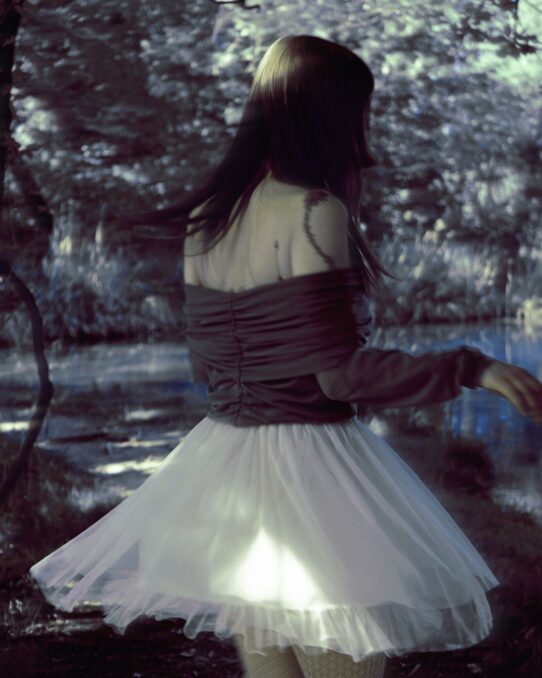
Naebula is a screenshot of what is happening at the moment
Given all, I am also of the opinion that an album is a screenshot of what is happening at the moment. And Naebula, for example, is a complete witness to this, because it represents you in a moment of fervent creation and search for a new sound at the end of the day.
Yes, I have to say that it’s an album that I’m really happy with, because regardless of what all the people who listen to it say or will say, it’s really authentic for me. In the sense that the things I did before this, that I like anyway, maybe you always know, maybe I would have done one thing better. Maybe now I would have seen another one again, but let’s say that in the previous episodes, in the full albums, in the full lengths, I had an approach that was unconsciously more derivative from other listenings. Just as an approach, not so much as a composition necessarily, but as an approach in some way.
Julinko: “I had to force myself to wait for time to pass”
I had to force myself to wait for time to pass, because basically, or maybe when I was younger, I am a little more impatient. This urgency to express myself that I had years ago was more fervent. And I had to throw it out. Instead I succeeded, I had to wait, and I’m happy because I feel that this is my authentic language. Maybe it’s not perfect, some parts could have been better, I don’t know. But when I imagined this record years ago, I more or less imagined it just like that. In the sense not in its details, but in its aura, in his general image. And therefore, I’m happy about this, I say it sincerely.
The singles Cloud Machine and Skinverse
I wanted to ask you about the single songs, you know, there are Cloud Machine and Skinverse. These two videos, I think that they are not random lyric videos. But that we have really well-thought, and they are beautiful mini-videos, shot with a very particular style.
Thank you. So I’ll tell you a little bit about these first two singles that were recently released. I have chosen Cloudmachine because, in a way, it is perhaps the most playful song among the ones present on the album. So I liked to release, at the beginning, a fairly energetic song. And then, because Cloudmachine in a certain sense also recalls the title of the album. Of the cloud, of fluidity, of vagueness, of cloudiness; is a new term.
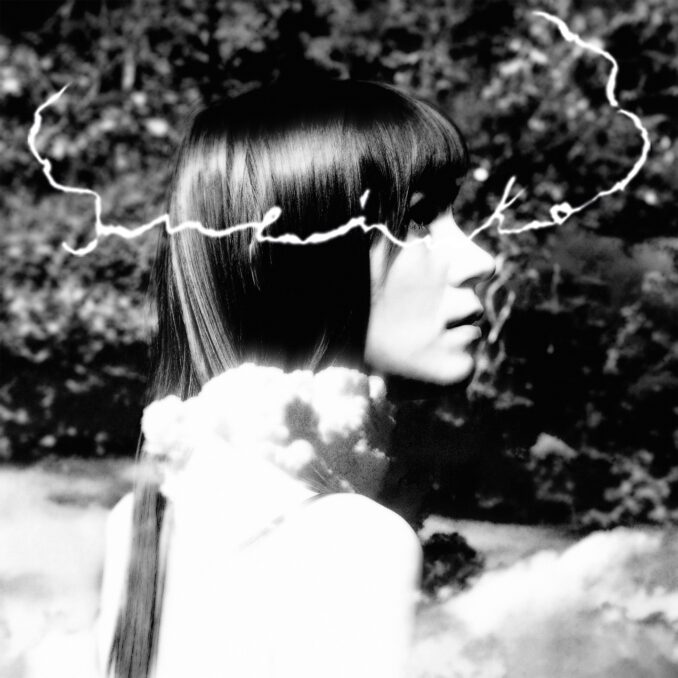
The singles Cloudmachine and SKIN DRESS [cont]
On the other hand about SKIN DRESS, I chose to bring it as a single because, when I played the album to several people – let’s say backstage. It was one of the songs that aroused the most emotions.
Both videos were shot with Elisetta, aka Elisa Fabris, who is a very dear friend of mine, videomaker, designer; many of Julinko’s videos have been made with her in the past. So it’s a collaboration: I often give her ideas, and then she elaborates them. We work on it together, but the visual cut is certainly hers. Because he has a very particular ability to see and edit.
The singles Cloud Machine and SKIN DRESS[cont]
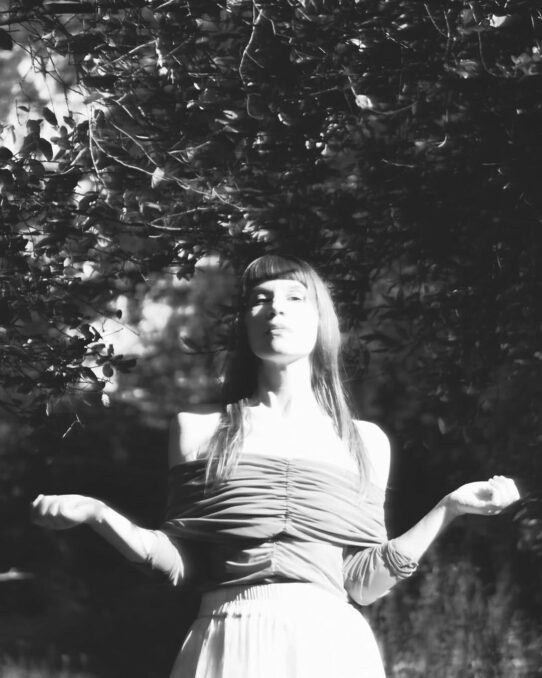
One interesting thing about the SKIN DRESS video is that it was filmed in the woods behind the house where she and I lived together for years. That oak tree on which I abandon myself is truly a presence that has been there in my recent years. In moments when, perhaps, I was a little depressed, I felt neurotic, I had anxiety, I felt too much the weight of things.
Hugging myself or in any case feeling, smelling, touching that tree always brought me into contact with a timeless dimension. Out of the press of the small things of life, but at the same time very rooted in the earth and in the materiality of time.
The idea behind the video for SKIN DRESS
So I came up with the idea of proposing to Lisetta a very essential video, without plot, without filters, which would convey precisely this naked relationship with nature. Between the nakedness of the body and the “skin” of the tree, in a certain sense. So, that’s a bit of the story of SKIN DRESS.
I must say that it is a video that perhaps is one of those that reflects me the most. It reflects me because it goes straight to the message, without gimmicks, in my opinion.
The idea behind the video for Cloudmachine
While Cloudmachine was a bit more playful elaboration: it was shot in a friend’s villa here in Veneto that has different areas. We liked to play with the library, with the search for books. Since the books have always accompanied me a lot and I always ask myself a lot of questions, I’m always looking for something, so those movements like that. And then the game of projections, always an overlapping of inspirations, suggestions, in constant change.
Screenshotting the moment
What I also wanted to ask you, by the way, is that I always think that an album represents a sort of screenshot of the moment, as I call it. And I wanted to ask you what Naebula represents for you?
Well, maybe I already told you a little last time, but it’s definitely a screenshot of a moment, but of a moment in which I wanted to try not to anchor myself to something external, such as references, let’s say, of musical approach or even of the feeling of the time.
That’s why it’s almost entirely a percussion-free record. There’s a percussion that I play – a drum – but I also play it out of time, so that’s what it is.
Screenshotting the moment [cont]
And then, another thing is that Naebula, also this title, represents a bit of being at the mercy of forces outside of me, in some way. That maybe one afternoon they really dragged me underground, seeing everything dark. And then the next day I woke up again and saw everything upside down, let’s say.
So I wanted, in some way, to reflect the transience of emotions, moods, etc.
And so Naebula is a bit of this vagueness, mobility, which appears, hides, and in any case always transforms.
About the title Naebula
You know when you have the image of clouds forming, then moving. In fact, it is called Naebula. One detail is that that word, “naebula”, written in this way does not exist. In the sense that it is not Latin, because it would not be written like that. I wanted to bring back an imprecision, a going outside the logic, even of language. From the schemes, for a greater adherence to sound, rather than to the logical sense.
The future for Julinko
Do you already have some ideas for dates, a tour?
Yes, now there are already some set, but they have not yet been announced because there are not many. For this spring I will tour mostly in Italy. I can already say one important thing: I will bring this album live in two versions. One is solo, as I have already done, that is, alone with my instruments. And the other is a trio version, accompanied by two very dear friends, Carlo Veneziano and Luca Ramon.
We will play the album in an expanded version: in addition to me playing organ and guitar, Carlo playing bass and organ, there is also Luca playing drums and percussion. So there is this desire to look for another stadium, while carrying the record around.
The future for Julinko [cont]
We are doing it, or rather, we have already arranged it, but always trying to remain faithful to the spirit of the record, very minimal in certain places, so it is not a “power trio” approach always at full capacity, etc. We’ll see, we’re curious to see how it turns out, how it sounds.
Yes, then oh well, when he starts playing, that’s a process too. You start in one way, but the street, the stages, the people, the time lead you to transform the piece. So it’s always step by step that things happen.
Last words from Julinko
Giulia, I wanted for the interview in general, because I found it very interesting to talk to you. Thank you.
Thank you for your attention, for your truly noble work of giving space to what other people do. It is something that, in my urgency to express what goes through me, I find truly noble that someone does it for others.