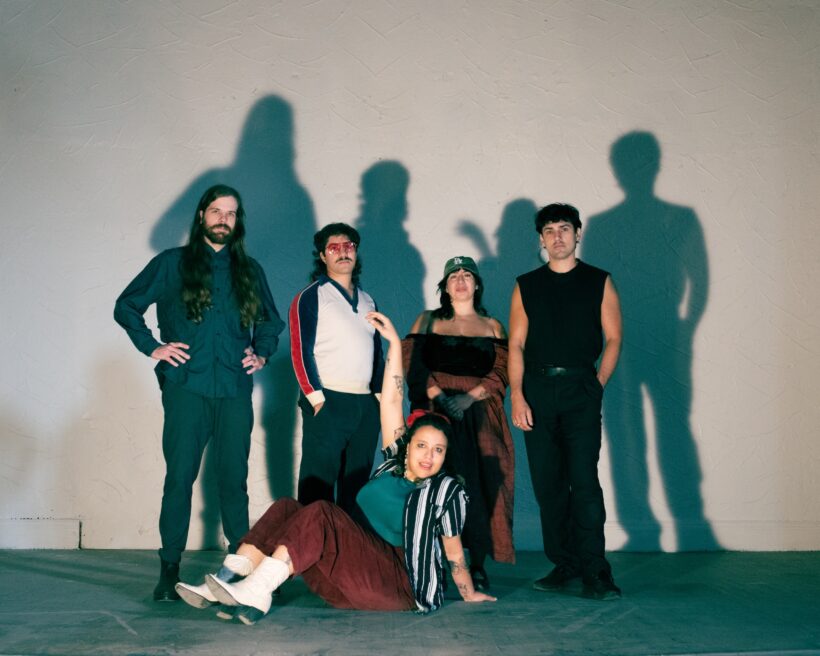
Nine years after their last record, Downtown Boys are back with Public Luxury, their first album for Sub Pop, recorded at Machines with Magnets in Rhode Island with Seth Manchester. Ahead of their European tour in December, with Italy at the top of their list, Victoria and Mary talk about making a record with five members spread across four cities, and about the Biennale in Venice (virtual) partecipation for Susanna Nicchiarelli Miss Marx‘s back in COVID time. They also discuss the political climate the album was made in, and what it means to keep making culture while it is treated as a threat.
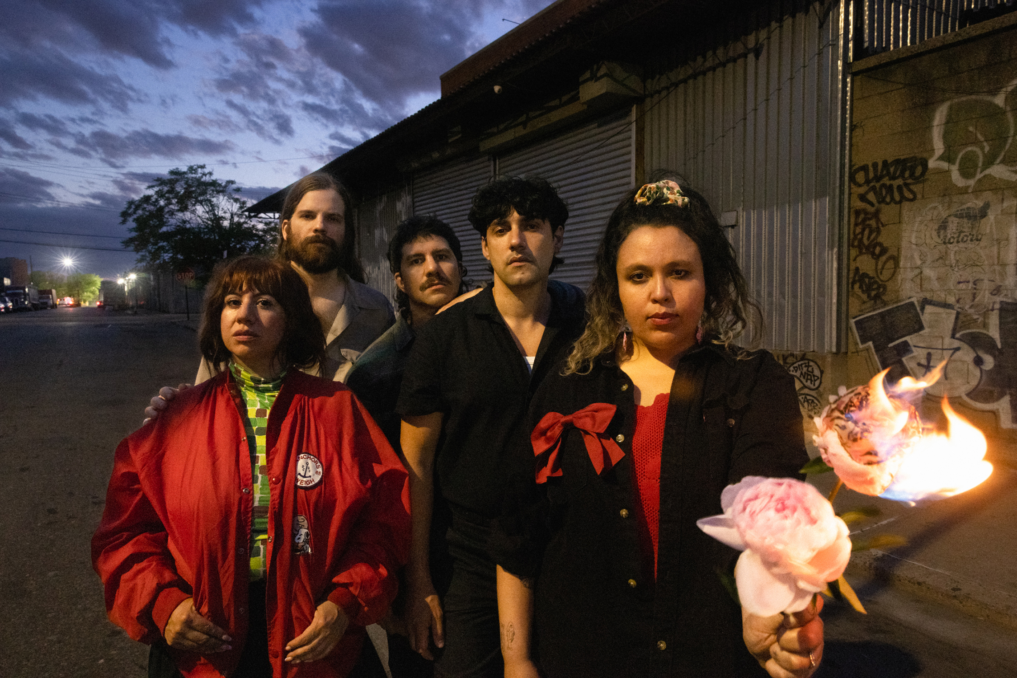
Welcome to Victoria Ruiz and Mary Regalado from Downtown Boys
So, Victoria, Mary, thank you so much for accepting this. I wanted to ask you how things are going.
Victoria: Thank you so much for doing this. We’re really, really excited. Things are going well. We’re really happy that the record Public Luxury is finally out on Sub Pop. It was really a dream to get to put another record out after so long, and Sub Pop really helped us make it happen. Then we got to record in Rhode Island at Machines with Magnets with Seth Manchester. That was also really great. We’ve gotten to do some touring on the record, which has been really exciting, and we’re headed to Europe in December, which is just so, so great. It’s definitely different from our last record.
I think, personally, we’re all older, just physically. But then also the economy and the context in which we’re touring is really difficult. So literally everyone that comes out, or that says they’ve listened, it means the world to us, because we know it’s hard. It’s a tough moment right now.
Downtown Boys collaborating with Sub Pop
Victoria, you’ve mentioned a lot of things that I wanted to analyze piece by piece with both of you. This album comes after nine years, and it comes from Sub Pop. We know the story of Sub Pop. My first question was: how and when did you decide to go on board with Sub Pop? Because nowadays it would be easier, and I’m being critical here, to be independent, seeing also the story that Downtown Boys has.
Mary: I think we started working with Sub Pop in 2017. I don’t remember quite how it happened. I think Victoria can talk about that. But it’s really an honor to work with them and to have more access to their resources and make our music more accessible. They’re such an amazing team, and I feel like they really make sure that our music and our albums get heard everywhere around the world. That is such an honor, and it’s so hard to do that independently.
Victoria: “Every time we even get to play is a labor of love”
This record is bigger and more expensive than anything you’ve done before. I’ve also listened to the previous album, and the moment I listen to it I thought, yes, this album is bigger than life. They are right when they say that. But my idea was: did Downtown Boys need that break of nine years to produce something bigger than life?
Victoria: That’s such a big compliment. Thank you so much for liking it. I think back on the past nine years, and I’m sure we all do. Basically everyone else in the band has been in other bands over the past nine years, and those bands have come out with many releases. So no one was under a rock musically. We also had the opportunity to still tour, and we worked on the Miss Marx soundtrack, which was really great.
Miss Marx was a movie that came out at the Venice Biennale in 2020. But then we also had the pandemic, and I think that was a really big moment for a lot of artists and a lot of musicians. It almost felt like a pause, because physically you just couldn’t have the same sort of interactions or the same concerts. But we’ve definitely played and worked on projects in the past nine years. And there are five of us who live in four different cities. So every time we even get to play, it’s obviously a labor, and also a labor of love, because it means putting five lives in four cities together.
Behind the political context of Public Luxury
That’s really a labor of love. Despite the fact that you live in four or five different cities, you win the battle for me, because I can understand how much goes on behind the scenes to say, let’s sit together and do it together, and then also to involve Seth Manchester and record and produce together with him. So it’s a real labor of love.
Victoria: It is. And I think recording and playing…
Mary: …it’s all in the background of the political context that we’re going through. It’s very difficult to pick up your phone and think about getting to the location where the show is going to be, or looking at soundcheck time, while also seeing a genocide streamed on our phones, and seeing attacks on our families and our bodies all over the country. So I think there’s no way to separate these things. They’re all very present, and none of it should be put aside. I remember Seth Manchester recording us and him running out of the studio because he had left the stroller for his kid in the car, and his wife was taking their kid to a protest. So it’s just a very different…
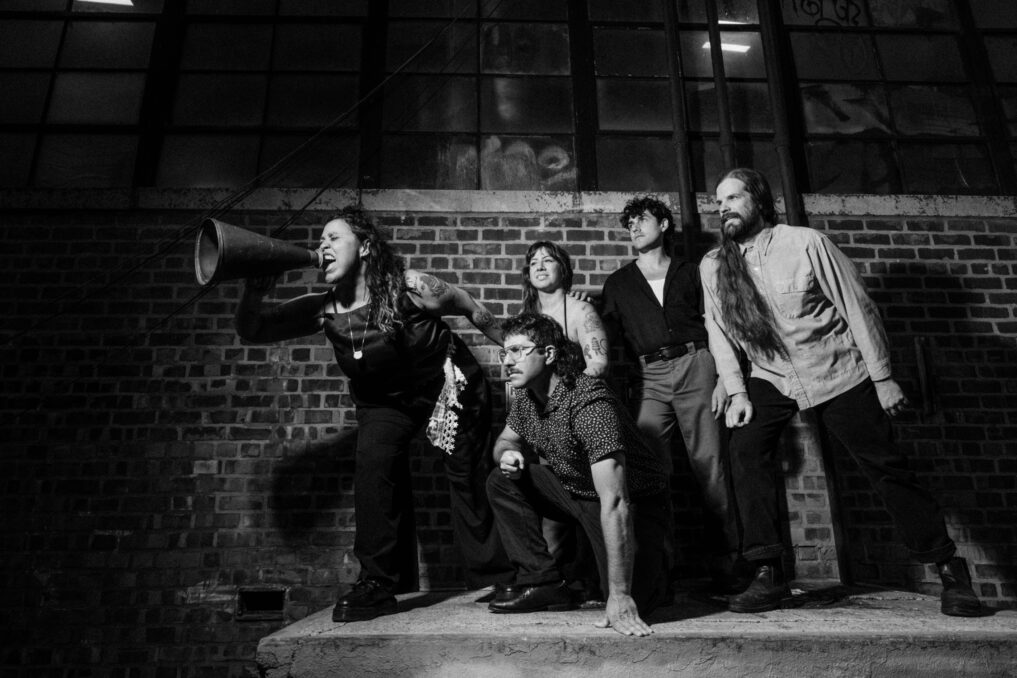
Downtown Boys: “This album reflects the politics of nowadays”
It’s like a puzzle that comes all together. Even though it’s a real labor of love, this album reflects the politics of nowadays, and politics stays in the center, in the front. I remember that nine years ago things were a bit different from right now, and it causes me a lot of pain to see how things have developed so fast in the wrong way. There is still the need for a band like Downtown Boys to keep the politics front and center. That’s a little bit of pain, because it says to me that we are back at square one in some ways.
The painful reality
Mary: It’s definitely painful, but it’s also a reality and you have to face it. I think it’s a powerful album, and I think it helps carry us through these times and everything we’re going through. It’s unavoidable; you’re confronted with this all the time. I live in DC, and we’ve been under occupation by the National Guard for the last year. Right before this interview I went next door to 7-Eleven to buy cigarettes, and there’s a group of them in the 7-Eleven just standing around. On my way to work this morning, they were there too. It’s just so unsettling, and it’s becoming normalized, the militarization and the occupation. It’s kind of scary to see how that’s going to develop. But playing with Downtown Boys, the way Victoria was talking about earlier, every time we get together it feels like a family reunion.
Downtown Boys: “Every time we get together it feels like a family reunion”
Yes, you know what I mean.
Mary: It’s so healing, and it helps us deal with everything that’s going on, for me at least. It feels like going back to a family reunion after a really long time, because life got in the middle and you had always postponed it. So when it happens, it’s a relief.
Miss Marx, Susanna Nicchiarelli and the Biennale at the time of COVID
Victoria mentioned Miss Marx, and these days there is the Biennale in Venice, so what better occasion to recall that collaboration with Susanna Nicchiarelli, the director of the movie. I’m Italian, and the Biennale is a big deal in my land. I wanted to ask you, from your perspective: I saw the movie, so my congratulations for everything. What was it like to participate in this event?
Victoria: Getting to be asked by Susanna Nicchiarelli to work on any project was really an honor. She was so incredible to work with and really kind to us, and she’s worked on so many political and visionary films. So first and foremost, working with her was the point of honor. We didn’t get to go to the Biennale because of COVID. What’s great about culture and art is that everything feels very fluid and static at once. So seeing the Biennale get protested last year, or really this past Biennale, because of connections to apartheid and to what’s happening in Palestine, is also incredibly important.
Uniting politics with arts
I’m going to tell you something more about that. Actress and director Greta Scarano, the host for this year at Venice 2026 showed up at the photo call with the symbol of a cucumber, which stands for Palestine. They had prohibited any sort of recognition of the situation in Palestine, but she united fashion with politics and used it to make some fresh air for herself, with a symbol of Palestine.
Victoria: Yes, and I think that’s what’s so beautiful about art: getting to use these spaces to bring out a political analysis and make sure that things don’t stay static. Obviously, our music getting used in a movie about Karl Marx‘s daughter is very exciting. I think a lot of us have spoken to Marxist ideas and thought about how capitalism has really affected us and our communities, and we often turn to Marx’s teachings.
So his daughter is an icon, and it was really exciting. But to be honest, what personally is very exciting is that Joey will tell us where the music is getting listened to, and it’s always really fun when we hear that it’s getting listened to in Italy.
That’s one of the big places that listen to our music outside of New York and DC. We’ve gotten to play in Italy a few times in the past nine years, and people tell us that they found out about that because the movie was on TV. For me, that’s really exciting. Yeah, they broadcast it on their TV.
Downtown Boys and Italy
Actually, I’m living outside Italy right now, but I read on the internet and saw the programming. It was really broadcast, I think, on a thematic channel for movies, the public one. It was a surprise even for me, because the movie, the music, it can be everything, calling for censorship in these days in my country, given also the type of politicians there. So I was surprised myself.
Victoria: Maybe Susanna will do a feminist take on Antonio Gramsci and ask us to use Public Luxury songs.
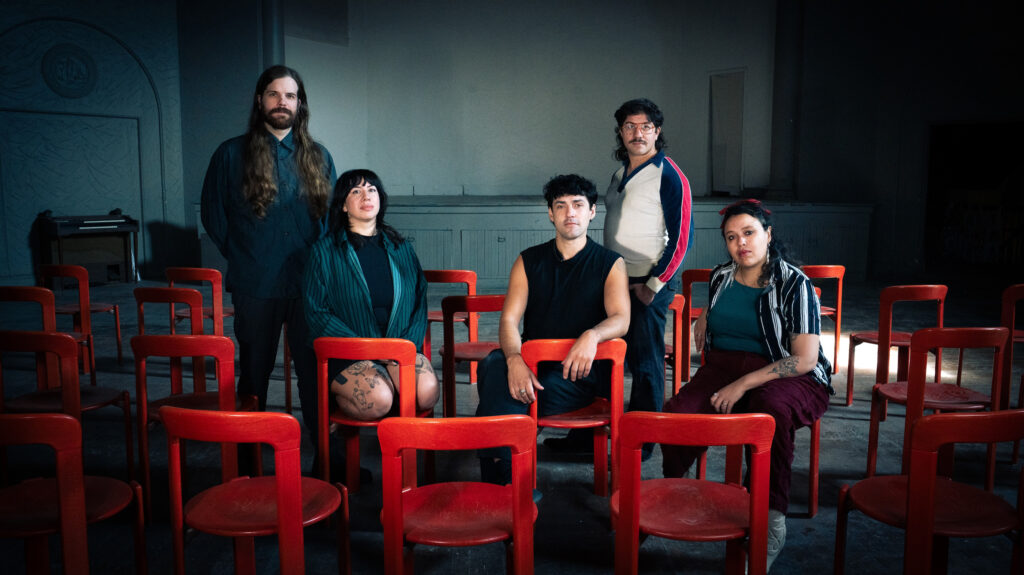
Downtown Boys and Italy (part 2)
Well, the more the merrier. Gramsci is really something sacred in my land, because he was one of the first politicians. He was a communist, of course, but he was born in Sardinia, a region where there were a lot of poor people, so he stood up for real people, not elitist stuff. So I’m really curious to see that mashup between your music and the movie, if it does happen.
Victoria: Fingers crossed.
Facing the changes in the musical business
Victoria and Mary, nine years ago the whole industry was different. How was it to be back after nine years? It’s probably one of the stupid questions I’m asking tonight, but nine years feels like a geological era in the music business, and you are confronted with a lot of things in the meantime. How did you face all that, between the socials and the algorithms and all that crazy stuff?
Mary: I feel like we spent a lot of the last nine years focused on writing, and when we were able to tour, we did that. But it was such a bizarre time. For the Biennale we were on Zoom, and we recorded a thank-you video that they broadcast, which was a very surreal experience. It’s really unfortunate we couldn’t be there.
A lot changed, and we had to be creative in terms of connecting with people. But that’s such a loaded question, because the DIY landscape and the music industry completely changed. Artists were able to organize, and we had time to organize and fight for better streaming rates and venues. We’re fighting against Ticketmaster and Live Nation. I think people really had time to sit and process their lives and how the music industry has been exploiting artists, and how we deserve better, and to connect with each other about that.
It’s no joke, what is happening right now. And I feel that all this business, I don’t know which name to use, isn’t respecting true art and music, because it sees music as a product. I never saw music as a product. I always saw music as something I get passionate about. It’s about art, not product and business, so for me it doesn’t have any place there.
Facing the changes in the musical business (part 2)
Mary: Yes. And just all of the DIY venues that were around for decades that closed; it’s important to support those. But at another level, what I’m seeing as an American is how difficult it is for artists from abroad to come to the States because of the visas. We are so privileged to be able to tour other countries without having to pay a ridiculous amount of money per band member, like tens of thousands of dollars, just to enter a country and play our music. I think that is part of the attacks on our country, our country attacking us: the attack on culture, denying and censoring artists from coming here.
“It’s a bit of a struggle for everyone”
Yes, unfortunately. But something has to come back, because without that we’re going to see everything closing and just big arenas, and not every band has the numbers for big arenas. Sincerely, I prefer the small DIY places that you’ve mentioned.
Victoria: It’s a bit of a struggle for everyone. And that’s also why it’s so integral to keep trying to play and keep trying to make culture, because it’s ultimately still seen as a threat. If it wasn’t seen as a threat by the oppressor, they wouldn’t try so hard to keep artists, information, and culture from being present.
Recently here in Texas there was an activist who was simply part of helping to make zines, and some of those zines were at protests. They were very informational and educational. He was charged by the federal government and is facing 50 years in prison, or was sentenced to 50 years in prison. I think about that a lot when we think about who is powerful, because clearly he had power that was seen as a threat by the state. That’s a reason why we all have to keep participating. It feels like such a contradiction sometimes, when you’re living check to check or can barely get out of bed, but then you see your comrades still on the line, and it’s inspirational.
The upcoming tour of Downtown Boys in Europe
I don’t have any comments about that, unfortunately. I feel like, what the hell, you need to give 50 years for just saying the truth? At the end of the day, I don’t have any words. I’m a bit in shock, actually. I just wanted to ask you: you mentioned that in December there will be a tour in Europe. What are you looking forward to the most? It’s a big achievement for a US-based band to bring it to Europe.
Victoria: Thanks for saying that. I feel like it is a big achievement, especially for female musicians and for musicians of color, and women musicians of color. It’s crazy that we get to do it, and sometimes I forget how blessed we are and how big of a deal it is. But one of the things I’m looking forward to the most is getting to go to Italy, because I love Italy. And just getting to play the shows to people who hopefully like the new album and want to hear the songs live. I’m super excited to get to play for people.
Mary: I agree. One of my favorite things about playing in Europe, and particularly Italy, is the weight that music has in the culture, and how they invest in music and culture very seriously. It’s so beautiful and inspiring every time. All of the amazing spaces we’ve played all over Italy in particular are so inspiring. It’s like, this is what we could be doing, and bringing that back home.
“It’s coming from pure passion”
It will surprise you, but my country doesn’t support the arts much. There are a lot of small locations that are closing. After that situation in Switzerland with the fire in Crans-Montana, I got to know, through awareness, that a lot of small locations are closing because they are getting stricter and stricter rules about safety. So I can tell you that the environment for small locations in Italy is getting worse and worse, while in Northern Europe it remains stable even after COVID, because they have governmental backing.
They get money from the government; they have subsidies. So what they do is big. It’s an act of resistance, I call it, a pure act of resistance. I knew some people who had a small venue and had to shut it down because of too many rules, no money, no public support. At the end of the day you are like a business: you have to pay taxes, and if you’re going to lose money, you also have to shut down the venue. So what is happening in Italy is a pure act of resistance.
Mary: You can feel it. It’s coming from pure passion.
Playing live is a pure act of resistance
Yes. What I always say is that if the government were interested in subsidizing these small local venues, I think it would also help the underground, the rock, the metal, the punk underground, to develop. Here in the Netherlands, every small city has a place where it’s possible to play, but it’s subsidized, so that helps. It’s all for the sake of the arts. But as I said before, it’s a pure act of resistance. I wish them the best, because it’s difficult with all the requirements that they keep asking for, and they have my respect. That’s the real story. I’m a bit sad to disappoint you both.
Victoria: I think that’s the thing, though. It’s like, the grass is always greener, but this is the reality, and yet you still have us saying it’s so much better than here. So if that gives you any idea of what we’re going through… Absolutely. We’re really lucky. We’ve obviously worked hard to get to this position, but we’re also really lucky that we have bookers and people who actually support and help us. Sometimes I can’t believe it. I’m always just shocked that there’s this infrastructure that supports us getting to play shows, like bookers and press. And thank you for what you do to participate in keeping and watering the last blossoms that feel like they’re there.
Thank you, much appreciated. Saying that, I want to thank both of you for making time to do this. I was honored to speak with both of you. Thank you again, Mary and Victoria, and thank you for continuing to resist and doing what you are doing.
Victoria & Mary: Thank you, thank you so much. You’re welcome.