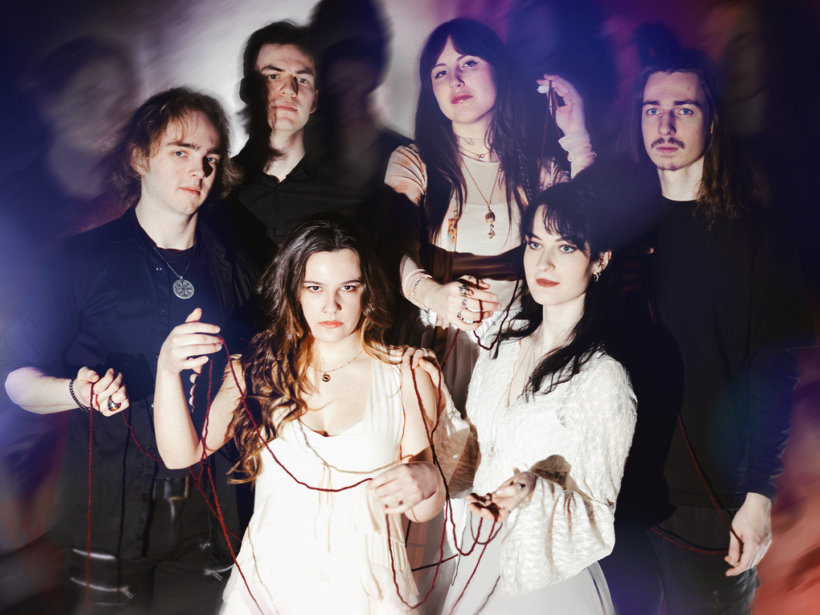
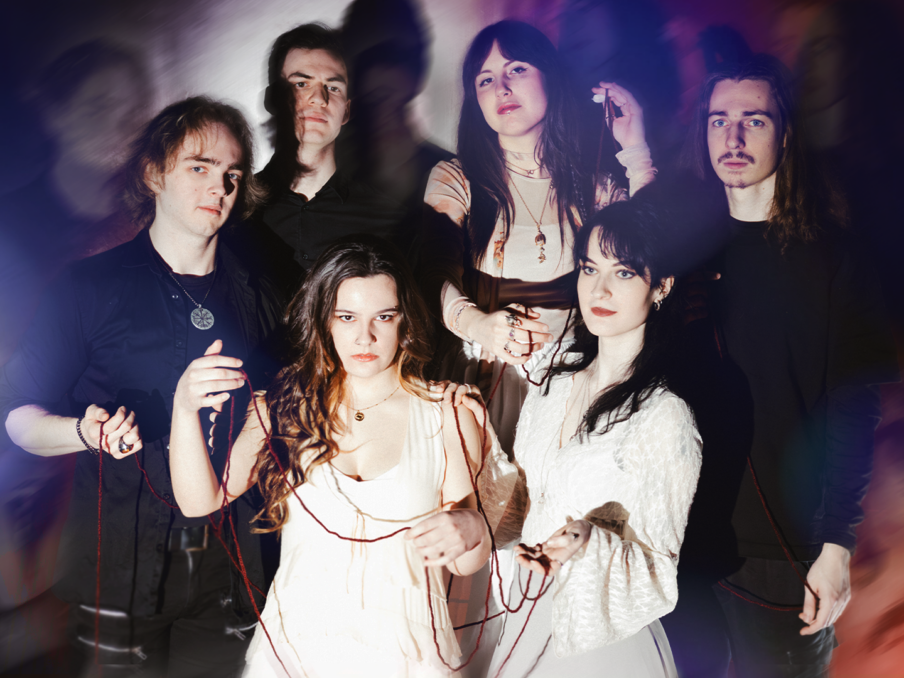
This weekend at Roadburn, Tria Nema will make their debut with a performance shaped by intensity, vulnerability, and a shared artistic vision. Born within the creative environment of Eindhoven’s Metal Factory, the project brings together three vocalists weaving their personal stories into a single emotional journey. In this conversation, Nina B. and Nina G. reflect on the intense preparation behind the show, the collaborative process that formed the band, and the deeper themes of fragility, identity, and expression that define their music.
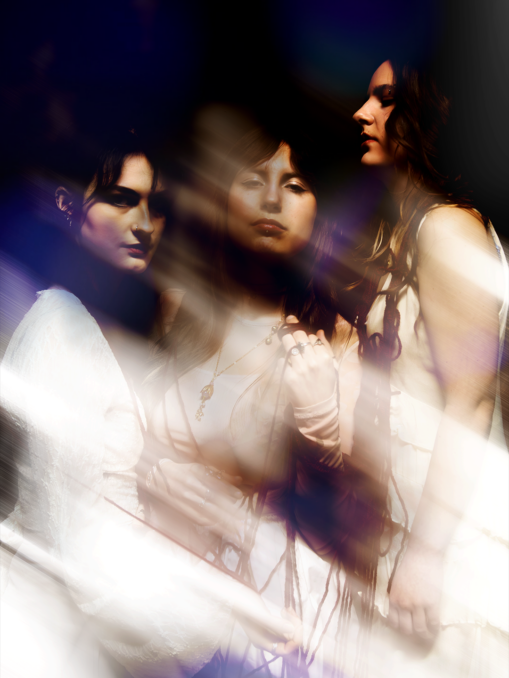
Welcome to Nina Grimm and Nina Boele from Tria Nema
So first of all Nina B. and Nina G. I wanted to welcome you here and I wanted to thank you for taking the time in such short notice. I wanted to start asking you how are you and how this preparation time is going?
Nina G.: Yeah. We are good, I think and we are at school right now. We study at the same school, which is the Metal Factory. And we are a bit in between lessons. But Metal Factory is also the place that’s giving us the opportunity to play Roadburn. They have an ongoing collaboration
Nina B.: And I think the preparation right now it’s going really well yeah it’s going really well. I have kind of the feeling that I’m flying somewhere in between because we worked very hard on our debut at Roadburn for about half a year. And now it’s so close I have the feeling that I’m kind of not even noticing the things around me. I’m just focused this Saturday.
Nina G.: Now that it’s Roadburn week, it’s even more crazy. It’s so close and the preparation now is about refining little things. So, we were even more busy with rehearsals than a few weeks ago. Right now, we have a lot of cool opportunities and work on social media and little details.
Starting Tria Nema
Absolutely, you just mentioned that Roadburn is collaborating with Metal Factory in Eindhoven but I want to ask you more about Tria Nema. When you got together all together and formed the band? Also, is the band independent from the school and Roadburn also?
Nina G.: So the way it works with the collaboration between Roadburn and Metal Factory is the following. Since 2023, every year Roadburn gives to the Metal Factory and specifically to a specific coach, that’s Michel Nienhuis in this case, a sort of framework.
And Michel and our other teachers such as Marcela Bovio, they think who could be a good fit for this specific framework. Subsequently, we can apply as students. Actually, I also applied for the 2024 edition but then I was playing on keyboards for that specific band.
The involvement of Roadburn
Based on the applications and on the framework that they receive directly from Walter [Roadburn’s artistic director], they decide what the band is going to look like. In our case, we already had sort of framework regarding the genre and the themes. Since Michel thought that it would have been interesting to have more than one vocalist, we got really lucky because three out of four of us were chosen. It’s a high number and we already worked together for example you were at the Ayreon concerts right?
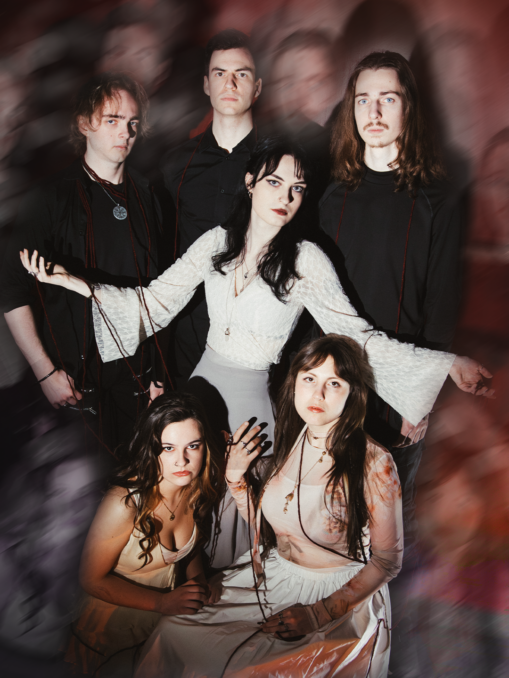
Knowing already each other
Funny story: I was coming from from Rotterdam to meet my friends from Italy. They were at Marcela Bovio’s and they bought Nina’s album. So, they started to praise about you. Then the faith wanted that I was walking on the main street in Tilburg. And I met her and I bought from her CD literally on the street.
Nina G.: Yeah, that was really funny and I think that was on the Friday. But on the Saturday, Nina B. and the other singer, Indy, played an Ayreon flash mob in which we sang together a mashup of songs to entertain people who were in the queue. So we already worked together before. Given that, we knew that we could harmonize together. And finding ourselves back together in Tria Nema was perfect. About the rest of the band, they all our friends from school. So it was really easy to make it our own after a bit.
“Everything spins, but I want to follow your lead”
Yeah, and I keep checking your socials and there is this small video about you girls are singing “Everything spins, but I want to follow your lead”. I got really curious about it. I like the fact that you are not revealing everything on Instagram. And that leaves me also much more space to think and just listening to it.
Nina B.: That’s nice, it’s good to hear. It’s indeed a part of one of the songs that we will perform. Our set is very specific because it’s a sort of journey through our emotions. It starts a little bit darker and this song is actually right in the middle of the set. It’s precisely in the middle of the journey. Given that, we decided it to release a small vocal appetizer to give to the listeners a little bit of a feel for what’s going to happen. However, without giving too much away.
Tria Nema main concept
Right now, you said that the main concept of the show is a journey into emotions. Do I must think that there is also the idea for a full length? Because if I think about the spectrum of the human emotion you can I think at least three albums…
Nina G.: Yeah, this is more about our own visions as women. So, for example, we have three different backgrounds and three different stories. But these three stories are being told through the music that we will play at Roadburn, and they intertwine with a common thread.
That’s also in the name of the band. In fact, Tria Nema means, in ancient Greek, it means three threads. And these threads are our stories intertwining with a common theme, which is getting through dark places and becoming a better version of yourself as a woman. Everything is narrated from a female perspective, and we try to celebrate fragility.
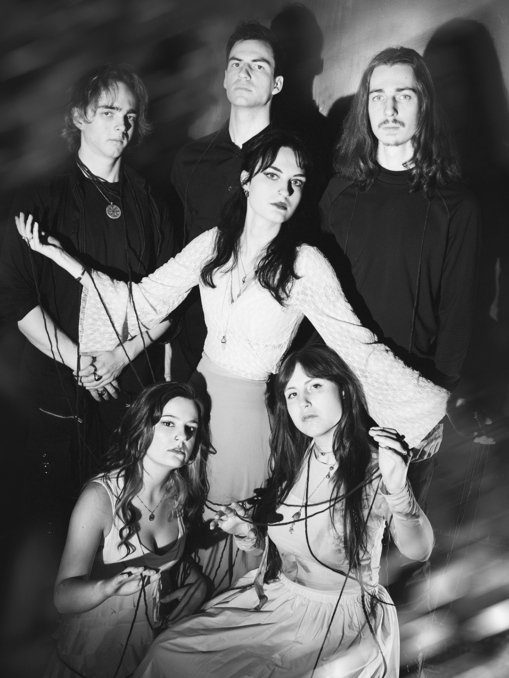
The three threads that are intertwined in Tria Nema
Nina B.: I think what you said, like you can, about emotional journeys, you can write 300 albums and still not be done. But I think that we all chose a very delicate part that was close to us when we were writing the songs as well. So that it feels very real and that we can convey emotions that are important to us at the moment. We wrote the songs, which, in my opinion, always makes it a little more tangible for the people who are listening to it.
Of course, of course.
Developing the ideas for the show
Could you tell me when you started developing the ideas for your lyrics? For example, you mentioned that the band’s debut show followed a format provided by the school, which suggests some structure and expectations. At the same time, I imagine you were working under time pressure and needed to deliver something of high quality. How did you manage to balance those demands—your school responsibilities and your artistic process? What was that experience like for you?
Nina G.: Well, we started in late October, I think, with everything. The first thing that we ever decided during a meeting just with the girls, was the themes that we were going to bring into the music. And which was going to be our main focus. And what was going to be the common theme in between our stories.
Developing the ideas for the show [cont]
Then our coach Michel already had some snippets of music that have been rearranged and readapted to our stories. And we wrote the rest was missing. A lot of times someone from the band, both instrumentalists and us vocalists, would write either a part or an entire song. Then the song would be reworked with the whole band and with our coach. So, yeah, we were in a big time crunch.
Developing the ideas for the show [cont]
For example, for us vocalists, something that took a lot of our time were the harmonic arrangements. Writing parts for three different voices for all the songs took really long. And we were always with close deadlines. But we, yeah, this is part of our job. We do get stressed, but it’s also such an honor to have these opportunities that you have to make it work.
Developing the ideas for the show [cont]
Nina B.: Yeah, because I think that for everyone it becomes top priority. And that’s also the luck of it being that we are, of course, studying at Metal Factory. And this is also something that Metal Factory provides us. There is some understanding that like for now, Roadburn took priority than regular classes.
So with that, it is allowed that sometimes for regular school, you do a little bit less than you would normally do. We could make this work because for us, this was all very important. And yeah, especially with writing vocals for three people instead of one, that takes a lot more time than we thought in advance, I think.
Aside time pressure and harmonization
Yeah, and now it sounds an easier question to reply, but I don’t think so. Which were the challenges that you have faced besides time pressure and writing three type of vocals for the harmonization?
Nina B.: I think the biggest challenge for us as a whole group was how to get the balance of the sound right. Of course, you have the vocal harmonies and they are very intricate but there’s also still a guitar player and a bass player which are also playing their stuff. Then there’s also a lot of synthy sound which require their space and to get it on a balance.
Aside time pressure and harmonization [cont]
Everybody in the band has to have their right place in the mix. And it is actually something that I think took the longest because a lot of our rehearsals were just singing the songs. Then our coach changing tiny things in the mix and how it would sound in the room. Indeed, every room it’s different. It was something that we needed to do again and again and again.
Actually, every rehearsal was basically figuring out how to get everybody audible in a way that works with the music.
Aside time pressure and harmonization [cont]
Nina G.: Sometimes we also had rehearsals where we were 40 minutes just sitting thereand apparently not doing anything. But two people are being completely busy with figuring out the routing of the sound and we’re just waiting for them while doing the best they can. It’s just part of it. But not anymore. Now everything’s figured out. It was more at the beginning of the process.
Celebrating the Metal Factory
Yeah, that’s interesting. and I like how the Dutch schools give also the space for this. About that, there was a short documentary regarding Metal Factory on Reuters. On which it was featured one of your teachers, Marcela Bovio. I didn’t expect that Metal Factory has a lot of programs dedicated for bands and to learn about the backstage and the promotion.
Nina G.: For example I have a master’s degree from the conservatory of Milan. I am a trained musician and I could have stopped there but I really needed a specific network and specific coaching on the genre that I want to play. When I knew that Marcela was teaching there, I just came here for this school.
Celebrating the Metal Factory [cont]
Nina B.: What is great about Metal Factory is that it’s also really focused on actual professionalities between the musical business. You’re not leaving the school with the idea that you perform in some bands and then just figure out how you’re going to go on. On that purpose, we actually get a lot of professionals from different side of the musical industry.
Celebrating the Metal Factory [cont]
They come at school and explain for example about how a backstage works and things like this. Also, you can have the experience playing at a real big festival which it comes very close to reality. I think that’s very cool because you you’re already in the world that you want to end up in a little bit.
Nina G.: For example, Nina B. is really good at drawing and with art and you get some opportunities to design logos or artworks for bands. Also, our logo is designed by Nina B. So, it’s a school that really encourages being part of the industry in 360 degrees.
Possibilities for Tria Nema after Roadburn
I know that upcoming Saturday you have the debut at Roadburn in Tilburg and after that what is the strip on the horizon because such a huge debut comes with a lot of responsibility and expectations. What would come after that?
Nina B.: I think that first of all we are all going to take a very nice holiday because we worked so hard the last few weeks. We held several rehearsals a week and I think that first of all we all need to let everything sink in what happened. Then after that I think we’re going to look for some opportunities where our concept would fit. Given the musical intricacies, it’s not really something you would place at a metal show.
Nina G.: For example, each of us have our own bands in which are lead singers, if we would have some evenings together. Maybe that would also be a place where Tria Nema could play something special for that evening.
The best place for Tria Nema
Where do you think it would be fitting to play Tria Nema’s music between a theater or in a small place?
Nina G.: Well, I think Roadburn is the best fitting place. But knowing a bit from what Michel does with Autarkh, I think Tria Nema would be really interesting—not necessarily for a standard concert, but more as an event. Sometimes there are bands that play at museums, for example, for a specific festival or event, and I think we could be one of those.
Anna von Hausswolff, Marissa Nadler, Emma Ruth Rundle and Tria Nema
But you know, I see names—you quoted names like Anna von Hausswolff, Marissa Nadler, Emma Ruth Rundle—and it’s strange, but they play metal venues. When I attend their shows, because I went for Anna and Emma a couple of times here in the Netherlands, most of the time I saw just metalheads—Opeth and that kind of stuff. Even though I’m a metalhead myself, I still find it strange and nice that those three artists appeal to a metal crowd. So in that sense, I see it also for Tria Nema.
Nina B.: Yeah, I think you’re right about that. It will definitely not appeal to everyone in the metal crowd, but there are some bridges that can be made between metal music and the stuff that we’re doing. So there are probably going to be some people who like metal who will like this. So yeah, I think we can make something out of it.
Going for big emotions is something that metal lovers excel at
Nina G.: I think part of this answer is also something that Marcela told me just a few days ago at the auditions. She said that going for big emotions—so big that they’re almost scary—is something that metal lovers excel at. A lot of artists who make more mainstream music, it’s not that their lyrics are not deep, but there’s always this sort of taboo about not getting too deep.
They aim for something recognizable for everyone—like relationship troubles—but treated in a way that’s easy to connect with, not in a way that’s deeply life-affecting. While love songs in metal are devastating, for example. It’s the same topic, but how deep do you want to go?
Metal dares to be vulnerable in a sense
Nina B.: Yeah, I think you point something out there—that metal dares to be vulnerable in a sense. They dare to say something more with music than most mainstream music, which tends to be a bit safer when it comes to emotions and expression. And I think that’s a bridge we make with our show as well, because we also dare to be vulnerable.
The future for Tria Nema
Okay. And considering all this, do you think it’s going to be possible to have a release of Tria Nema next year?
Nina G.: We didn’t talk about it yet, but I think we all feel it would be nice to record the songs we wrote for Roadburn, because we do have enough material for a full length. But we haven’t discussed it yet—we’re so busy with the show.
The future for Tria Nema
Nina B.: Yeah, we’re living for this moment. And I think it’s very possible, as Nina G. says, that we all think it would be nice to record and release this. But honestly, at the moment, we’re thinking: let’s first do the show. Take a couple of weeks of rest, and then we start talking about that again.
Yeah, okay. So first of all, I want to thank you, and I wish you good luck for Saturday.
Nina G.: Thank you.
Nina B.: Yeah, thank you so much for taking the time to sit down with us.