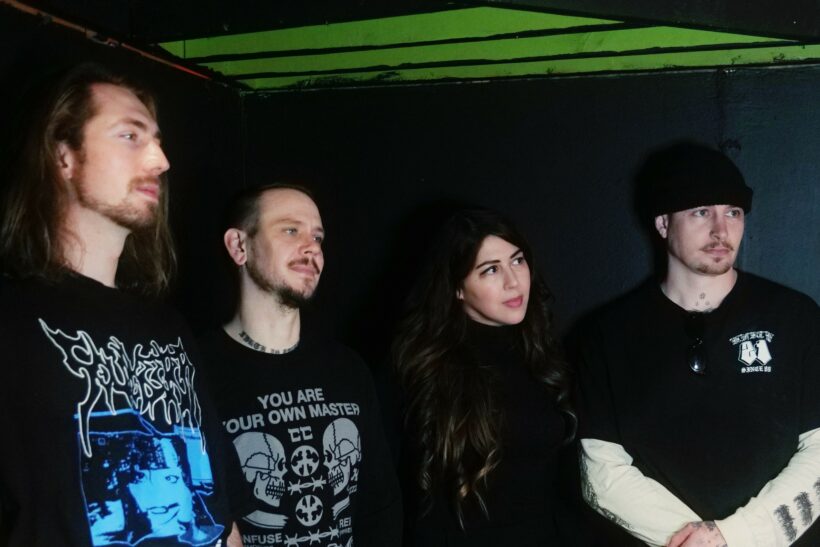
I was so happy to finally sit down with vocalist Lis DiAngelo and guitarist Brian McClelland from Filth Is Eternal for a truly heartfelt chat about their new album, Impossible World. Even though it all came together at the last minute, they showed up full of energy—Lis glowing with excitement about getting back on tour, and Brian just as enthusiastic about the album’s release. We ended up diving deep into everything from how Impossible World grew out of Find Out, to the emotions and themes behind the songs, and even the custom gear they’ve built themselves to shape that fierce, unmistakable sound.
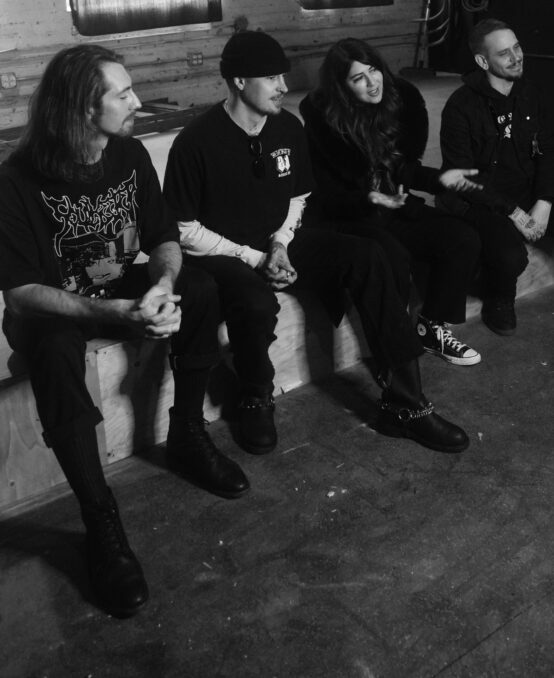
Welcome to Filth is Eternal
So, first of all, I want to welcome you here Lis and Brian, and I wanted to welcome you here and thanking you for, you know, taking the time to manage it in such short notice because it was a bit crazy. But I’m happy that both of you are here. How are they and how are you?
Lis: Really good, actually. I’m excited because we’re gonna be getting back on the road soon, getting back out on tour and getting to start that tour with a kickoff in Tacoma, which is just south of Seattle, but it’s a beloved city, and it’s just great to be back on the road.
And what about you, Brian?
Brian: Yeah, I’m getting excited because we’re happy to have our new album, Impossible World, coming out next month or this month.
Lis: Yeah, this month.
Brian: We’re excited to do it. Get out there and play some tunes.
The new album of Filth is Eternal: Impossible World
So Brian mentioned Impossible World, so I wanted to both of you ask about, you know, the album production when you. Both of you started, you know, together, the ideas for it, because, let me tell you, Find Out was like, it’s dropped a bomb, actually, in 2023, musically speaking. So the expectations were quite high and must admit.
Lis: Yeah, absolutely. Go ahead, Brian. You can start.
Brian: Yeah. After Find Out, we had been writing songs kind of the whole time. Through the process, we try and stay continually creative and stay active writing. And Lis came up with the title Impossible, Impossible World shortly after we completed Find out, and we kind of just knew that that was going to be the title for the material. We don’t always get, like, the name of the album up front, but that just came to us, and we knew that that was becoming the vibe of the album.
The process as we were in it. So we started writing songs in probably 2020, 2022 or 2023, right after recording Find Out, and we just hit the ground running. You know, we went through some lineup stuff, but we just tried to put together the best tracks that we had and just really lean into, like, catchy material and heavy.
The new album of Filth is Eternal: Impossible World [cont]
And we wanted to find a way to embrace our favorite parts of Find Out and grow them and develop them a little bit more from a songwriting perspective. So I’m really happy with how everything came out.
Lis: Same. Yeah, I think that it was also an opportunity. I was really interested in pushing the limits of, like, melody and, you know, leaning into that more than I think we ever had in the past. And so it was just was a fun challenge, and it was exciting to try to go down that path and just really lean into that.
The challenge behind Impossible World
A question to both. Which was the most challenging aspect of Impossible World?
Because, you know, trying to step up every time. Now, I don’t want to mention the word again, expections, but they are put there, and it can be challenging also to have it here, that word, you know, it can be stressful, you know.
Lis: I mean, I think when we’re going from record to record. You know, I think, Brian, you might agree we always kind of just do what feels right at that time. Just coming off the heels of Love Is a Lie, Filth Is Eternal.
And I think just taking it each time in stride and kind of like really leaning into whatever it is, what we’re experiencing at that moment and then, just going with it. But to your point, yeah, there could always be those in the back of your mind. There’s a little bit of a pressure that’s there. I think that goes for everyone who’s a creative, right? Even if you’re a writer. I’m sure you experience the same thing.
You’re constantly developing your skill as well and your art. At a certain point, we all just share that bond of just trying to always push ourselves to be stronger as artists. I think that’s a great question, actually. Brian, what do you feel about that?
The challenge behind Impossible World [cont]
Brian: Yeah, you know, I think coming out of recording, find out. You know, every time you do something with the creative process, I always think your output is only as good as your input. Actually, the input that we had of learning from making Find out, we learned a lot of great stuff from our team on that record. And I felt emboldened to lean in a little bit more and develop the sound.
Indeed, there were some things that I knew I definitely wanted to ask for sonically, in order to develop the songs for Impossible World, to make them a little bit more from the last record, things that we knew that we wanted, things that we wanted to try.
And then sonically, stuff that we learned was like, more of our favorite part of, you know, building songs and hooks. So I think we had a great experience with Find out.
And rather than letting the expectations give us a little bit of anxiety, I felt actually strengthened by those experiences. You know, I felt like we had a really good input going into the songwriting and production.
Filth is Eternal: punk immediacy, the hardcore intensity and melody
Yeah, absolutely. I feel like this album is a turning point for Filth is Eternal, actually, because I feel there is some punk immediacy, the hardcore intensity, while there is a lot of melody and which also shape up in some sort of grunge/alternative rock. There is a sort of musical palette that is there and it’s much more emboldened this time and much more, you know, clearer with that direction, if you allow me those words.
Lis: Yeah, absolutely. I appreciate that. That’s sort of the sensation that I was experiencing during this process. I also think that in the past, for my side, it’s been pretty reactive, but there were more opportunities on this record, I think, to also be collaborative.
Indeed, that was a little bit of a change from the past. Usually the batch of material gets created and then I come in and I figure out what I’m doing. Whoever this time there were opportunities and we learned from this record how we want to move forward and be even more collaborative. So the next record will shape even differently.
The important lesson for FIlth is Eternal on this album
Okay, so for they, I wanted to ask them which is the most important lesson that they have learned this time.
Lis: Yeah, I mean, Brian, do you want to start?
Brian: Most important lesson? Yeah, you know, I learned that working with Taylor Young.
It was a great time working with him. What I’ve learned is to really just lean into what I wanted to hear from the production element.
Sometimes, we were talking about expectations or feeling a little anxious in the production phase. I learned working with him to just lean into what sounds good in the room and what feels good and really just trust your instincts as far as those things go. Actually, when you get into recording, it can be easy to just not know how to do certain parts of it.
Is this good enough or is this going to sound different or how do you put that together? But just use your ears and use your instincts and just make what feels the most with the material.
Becoming “a little bit more academic about music”
Nice and important words, I might say. Because if it’s also difficult to follow the guts. So it’s also difficult because, you know that you put a lot on the plate at risk.
Lis: Yeah, absolutely. I think for me, when I think about what I really took out of this process was I wanted to turn a corner myself and I think become a little bit more academic about music. I think up through this record I’ve been a little more intuitive.
And I think that where this record, something just sort of clicked and I wanted to learn more music theory and really start down that path and be able to learn the language of music. I started with this record, with that approach and then really start to lean into that even for the next one, even more so.
Indeed, my biggest lesson is that I thought I would be hindered by it [laughs]. I don’t know why that was in my mind this whole time. But something broke loose and I realized the power of knowledge. And the more that I learn, probably the more effective I can be.
Becoming “a little bit more academic about music” [cont]
Absolutely. I do agree with they, I mean in general people think that academia
They think well it’s boring. But it’s not that you need to find the right way to clutch it and mold it and understand it.
Lis: That’s right. And speak the language. I didn’t realize how quickened things can move.
And when you have the vernacular or you’re able to speak in terms that people can understand in the room. I work with some pretty talented amazing musicians. So that for me was the biggest paradigm shift is learning to embrace that.
The academic backdrop of Impossible World
So this great album, allow me this word, it has an academic backdrop. There are some themes in this album that pure academia from my perspective. In the lyrical setting of Impossible World features thematics such accelerating gentrification, uncheck technology which is unfortunately the reality slow creeping of authoritarianism. Given my studies, for me these topics which used are quite familiar.
It’s really difficult to explain those topics — especially to someone with a lower level of education. I find it challenging myself, even when I’m studying them. So I try to put myself in the position of a regular listener, someone without academic training, to see how it might sound to them. So I really appreciate that Filth Is Eternal takes also some time to speak about it.
Lis: Brian, do you want to kind of go into some of that? Because in general you’ve got some pretty great points that we’ve made in the past in regards.
Brian: I think music is a great unifier. It speaks to everyone. You can feel what the song is about, whether or not you know what the lyrics are. And lyrically, you know, and thematically what we deal with being up here in Seattle is.
There are elements of increased militarization from the police in our neighborhoods. We live in a traditionally, like queer arts neighborhood and we see more cops around, we see more surveillance popping up. We had a camera pointed at our apartment, which is very new in the United States. Recently, you know, they’re installing new things around the city.
The strenght of the community and the Vera project
You know, if you allow me that, I find it quite creepy and scary.
Brian: There are experiences happening in the city that I think that a lot of people can relate to where we live. Some of these elements may be like creeping into your life in different ways.
A lot of times, like the arts community in Seattle has faced increasing cost because of tech companies coming in and redeveloping the neighborhoods and pushing around the affordable spaces that artists use to make their work. Indeed, it can be one of those things where this is just the experience that we live and this is what motivates us to make really energetic music. And this is what we talk about.
The strenght of the community and the Vera project [cont]
When we’re talking with our community, we hear what they’re dealing with, we see what we’re dealing with. Then we work with community projects like the Vera Project which is a youth organization that offers classes for people after school classes, art classes,and audio production classes.
So that’s the way that we build our community to deal with all of those things. And then that’s the creative output that we all sort of have in dealing with these concepts around the city as they’re happening.
“We want to get rid of this authoritarian, oppressive government”
First of all, congratulations for your commitment. Secondly, well, yeah, I’m a bit scared from what I’ve heard right now, sincerely. The news it can be, because it can be much more filtrated. We got the whole situation about Pennsylvania one month ago, but about Seattle, I wasn’t aware of that. So that makes even much more preoccupying the whole situation.
Brian: There’s a lot of great things about the communities across America. It’s built on these amazing creative neighborhoods. And, we are not ultimately what our government is doing. You know what I mean? In the States, we are people that most people push back against oppression. Most people don’t want propaganda.
They don’t want destruction of vulnerable populations. They don’t want oppression of marginalized communities. We want to build our communities to have long term growth and sustainability. And, you’ll find that across America and there’s good people in every state.
Red and blue states, we want to build and we want to get rid of this authoritarian, oppressive government. We don’t want this fascist bullshit. So, you know, things will keep happening, but the important part is that we grab everyone and push back against that oppression.
Filth is Eternal: : “we have to be able to be sad as well and recognize that emotion”
First of all, I mean, I do agree with your words. So much respect that you take a stand against. And, yeah, both of you take a stand against. Because I’m against. I don’t like that. I believe that a human should have a community where is based onto. So hearing this, it makes me feel really sad.
Lis: And that should be recognized. I think that’s important to be able to express that. And it should be validated. This is a sad time. And I think that we balance that with protest.
We balance that with our community and coming together.
But we have to be able to be sad as well and recognize that emotion. And, I think there’s a lot of that in this record. Indeed, there’s a lot of a moment of recognition that we can take a second take a pause to feel. And to just be and then move forward and fight and protest.
Impossible World as a title album
Absolutely. I think also I had the feeling about this album that was much more choral than the previous one, and now I understand where it does come from, all that.
Brian: That’s a big part of, you know, making heavy music for me, has always been about the catharsis and sharing that with people. If it sounds extreme and it sounds intense, it’s because those are the feelings that we’re processing out. People at the shows get that, and they come to the shows and you want to have something where you can expel that energy.
And when we talk about with Impossible World as a title is when the world feels impossible, you have to sort of make the impossible happen. You have to reach through all of the noise and what you think may not be possible, you have to find a way to do it. So that’s part of what we embrace is like a rallying call with the concept of this record.
The perfect tempest that came in disguise
And I mean, between the musical turning points in this album and these thematics, I think it’s the perfect tempest that came in disguise, in a way. So I felt also that it was now the perfect album, the perfect moment, even though everything is going terribly wrong? If you allow me those words. For sure, they are not nice words to say. I’m so sorry but it feels like that.
Lis: I mean, it’s interesting because you know, I think there’s an intersection between Brian and my idea about the record and I think maybe to add another, like, shape to it is, you know, in the middle of writing this record I was caretaking my father who was dying from stage four cancer.
I remember just everything felt impossible during that experience. And I just sort of realized that I couldn’t save him. During all this situation, I felt like I had to change my logic and realize that I couldn’t save him, but I could love him.
However, when I think about this modern world, you know, there are always going to be things that are outside of our control. Look what’s happening with Iran right now, but with that, I feel like there’s always something that we can do. For me, this record is just about finding a path through the madness of our time.
Filth is Eternal: “we always find our salva is in our community”
And I completely agree because amidst all this confusion, this sadness, these bad things that we have just spoken about. There is some sort of light that says, well, there is still something positive.
Lis: Correct. We have each other. That’s where we always find our salva is in our community. In meeting new people like you coming together, we can just have these really precious, special moments.
Get really real about our shared experience and the potency of that, I mean, that’s what carries us through. I think that’s why I’m so looking forward to going back on the road. Then getting back out there with our shared community across the country and beyond that.
“I’m so looking forward to going back on the road”
I don’t know when, when Filth is Eternal will be in Europe, but, I hope soon and I hope then I will have the chance to attend one of the band shows’.
Lis: We’re working on it actually right now [laughs].
Brian: We’re working with Swamp Booking. So if there’s anywhere you want to see us in Europe, reach out to them and let them know.
Filth is Eternal has developed the pedal Field EQ plus
Yeah, I will do that. I need to mention just one important thing. I know that for this album, Filth is Eternal has developed a pedal which is called Field EQ plus. I’m not on the technical side because I don’t play any instruments at all.
Actually, my curiosity is more on the side how Filth Is Eternal has developed that because it’s unique and it’s not distributed in the market so it’s not possible to buy it, and it’s just for you guys in the band to use it. So I was curious, how did you develop this?
Brian: Yeah, I made a couple pedals. Let me see what I got. [literally showing the pedals on video]
Lis: He’s gonna cry. He’s got some stuff on. [laughs]
Brian: On our Love Is a Lie, Filth Is Eternal album, we started developing some sonic devices to find the right kind of crunch, find the right kind of guitar sound.
And we ended up developing our first one. It’s called the Filth Eternal Echo Drive, based on a unit that we were using in the recording So, we were developing this during the Love Is Alive Filth Is Eternal record but then we ended up using this as the main sound on the Find out record.
Filth is Eternal has developed the pedal Field EQ plus [cont]
Subsequently, we have developed the new one which is called Filth Eq Plus. I’m building this out, actually, right now. I have the dots on my desk. So, this was a prototype of the eq [showing it on video].
Actually, we got these prototypes made together with our tech, who lives in Tacoma, Washington, Jeff, from Lemon Sundrop Electronics. And so he created these for us, and we went and recorded all of Impossible World with these devices, and we will be releasing them.
Momentarily, we’re just in the developing phase, so we’re getting these all finalized. And this is the final artwork that we have chosen.
Filth is Eternal has developed the pedal Field EQ plus [cont]
Nice.
Brian: Thank you. Following that, we will print all of our own merch, T shirts, and whatever with that print. And so now we’re moving into screen printing our actual pedals and everything.
Though, this is funny. This is the prototype, and then here’s the final artwork. And I’ve got the guts on my desk [both laugh]. This is the sound on guitar for almost all of Impossible World. We developed this and recorded this with Taylor Young and just cranked it up into a bunch of different amps to get that really gnarly saturation.
Filth is Eternal has developed the pedal Field EQ plus [cont]
So, yeah, I’m just amazed by that. Again, I cannot use it, but, I mean, that gives you that special extra because just thinking about to develop a pedal. Well, congratulations.
Secondly, well, I hope you’re gonna sell it also and distribute it, because, well, an extra dollar on a bank account of a band is always welcome, I think.
Lis: Yes. Money. [laughs]
Brian: Yeah, it’s fun because we were talking about, like you said earlier, how we have pushed it a little farther from Find Out. It’s just a piece of hardware, like a device where we said this. We can get a little bit more saturation out of that.
Indeed, the whole idea was it’s just part of the experience and we’ll have these up online for sale and we’ll have some at the merch table. Really it’s a cool that we can offer part of the experience of Filth Is Eternal to our fans and likemusician friends.
I think there’s something kind of magical in there. It’s a little bit of sonic sorcery. So it’s just cool to be able to share that kind of stuff with people.
Final words from Filth is Eternal
So Lis and Brian, I want to thank you both for your time. I hope I ask everything.
I hope it was interesting, not a boring interview
Lis & Brian: Very much so. That was very touching and wonderful and thank you for taking the time to talk to us about it and I can’t wait to hang out in real life. I’m sure we will have a great time together [laughs].